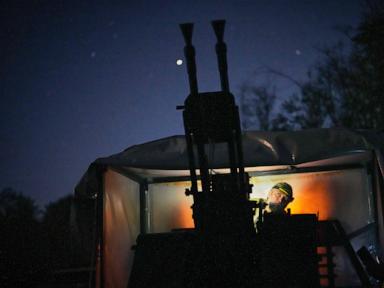
The rules of modern aerial warfare are rewriting themselves in real time over Kyiv. When cheap, propeller-driven Shahed drones first filled Ukrainian skies, mobile groups with heavy machine guns and acoustic sensors managed to blunt their impact. Those days are gone. Russia has rolled out a new class of high-speed, turbojet-powered variants—such as the Geran-5—that cruise at roughly 600 kilometers per hour. That is three times faster than older piston engine models. They scream across the night sky, flying at altitudes between two and five kilometers, rendering traditional ground machine guns obsolete.
Air defense units are left with mere seconds to react, and standard interceptors simply cannot catch them. Ukraine's existing domestic interceptor drones typically max out at 300 to 400 kilometers per hour. When you try to push those older platforms past their design limits, batteries overheat and motors fail mid-flight. It is a brutal engineering mismatch, forcing military planners into a desperate race against time to build faster, smarter air defense technologies before winter sets in.
The Speed Trap Facing Frontline Defenders
If you talk to commanders manning air defense shifts across Ukraine, the frustration is palpable. The threat has morphed from a slow, buzzing lawnmower sound into an invisible streak that flashes across radar screens as a tiny pixel before vanishing.
Units rely on a mix of electronic warfare and artificial intelligence to funnel incoming projectiles into narrow spatial corridors. This electronic funneling slows down or redirects some models, but turbojet drones shrug off basic countermeasures through sheer velocity. Older interceptor methods are failing because physics doesn't negotiate. To stop a projectile traveling at 600 kph, your counter-weapon needs to match or exceed that pace without burning its own internal circuits.
F-16 fighter jets can do the job, but they are expensive, require intense maintenance, and are limited in number. Scrambling multi-million-dollar fighter jets against every swarm of low-cost jet drones is a fast track to logistical exhaustion. That reality has shifted the burden entirely onto local defense manufacturers who must innovate under fire.
Inside the Race for High Speed Interceptors
Ukraine's tech sector has mobilized with wartime urgency. Companies like Vyriy Drones and other defense startups are racing to field a new breed of interceptors outfitted with specialized cooling systems and aggressive propulsion upgrades. These next-generation drones are designed to sprint at high velocities without frying their onboard power units.
Engineering high-speed interceptors is only half the battle. The real bottleneck is production scale. Industry leaders estimate that ramping up mass production of these specialized interceptor systems takes months of frantic industrial pivoting. While field testing has already begun on domestic interceptors designed to handle high-speed targets, bridging the gap between successful prototype and widespread front-line deployment remains a monumental challenge.
Combat evaluation is happening live. Ukrainian military leadership notes that these new interceptors are already seeing operational testing in active combat zones. Interception rates for high-speed variants fluctuate, and defense officials acknowledge they remain lower than the near-universal capture rates once enjoyed against slower, older drones.
What Happens When the Sky Speeds Up
The broader implications extend far beyond tactical airspace management. As turbojet UAVs become cheaper and more common, the economic equation of air defense collapses. Firing expensive surface-to-air missiles at low-cost strike platforms creates an unsustainable financial drain.
This is why low-cost kinetic interceptor drones represent the only viable math for the future. If a nation can build a high-speed guided drone for a fraction of the cost of a traditional missile, it can sustain a war of attrition. If it cannot, the skies remain open to relentless bombardment.
Innovation cycles have shrunk from years to weeks. The engineers who solve thermal management, high-speed battery endurance, and autonomous target lock-on at 600 kph will dictate the outcome of modern asymmetric air defense. The race to outpace the next generation of aerial weapons is moving faster than the machines themselves.