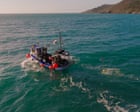
Every year, tens of thousands of diving birds make a fatal mistake off European coasts. They plunge beneath the waves in search of a meal, swim straight into invisible walls of netting, and never surface again. An estimated 95,000 razorbills, guillemots, and other seabirds drown annually as accidental victims of commercial gillnetting.
It’s an ugly problem that has plagued fisheries for decades. But a two-year trial off the coast of Cornwall has finally cracked the code using an unexpectedly low-tech solution: floating scarecrows and bird-shaped kites.
If you think putting scarecrows in the ocean sounds ridiculous, you haven't seen the data.
The Quiet Crisis Beneath the Waves
Gillnetting is devastatingly effective. These curtains of transparent or fine-mesh nylon hang vertically in the water column, catching fish by their gills. Unfortunately, they catch everything else too. Diving seabirds like guillemots don't see the synthetic fibers in time. Once they're tangled, they drown within minutes.
For years, conservationists wrung their hands while fishers absorbed the blame. Regulations felt clunky and punitive, often threatening livelihoods without actually fixing the ecological damage. Nobody wanted a blanket ban that wiped out small-scale independent operations, but the body count kept rising.
Then came a collaboration between ten Cornish fishers, Fishtek Marine, the University of Exeter, and the RSPB. Instead of slapping heavy fines or impractical gear mandates on working crews, they decided to test actual behavioural deterrents.
How Floating Scarecrows Trick Seabirds
The star of the study is a device called a looming-eyes buoy, known more colloquially as a floating scarecrow. Developed by Fishtek Marine, it features a spinning head equipped with two oversized, predatory-looking eyes. As a fishing vessel moves or tugs the line, the buoy bops on the surface and swivels, sending visual alarms to birds flying overhead or diving nearby.
Researchers also tested commercially available scarybird kites flying above the water.
They didn't just guess whether these gadgets worked. Cameras were strapped directly to boats to monitor real-time seabird reactions during a rigorous two-year trial. Published in the journal Conservation Letters, the findings turned heads across the marine biology community.
The numbers speak for themselves:
- The looming-eyes buoy cut the chance of seabirds getting caught by 59 percent.
- Airborne kites performed even better, slashing bycatch rates by 71 percent.
Tom Horton, lead author of the Exeter study, pointed out that this gives the industry some of the strongest evidence yet that simple, practical fixes can save wildlife without destroying fishing yields. Yann Rouxel from the RSPB noted that it marks a massive milestone in reducing bycatch without making life impossible for fishers out at sea.
Why Seasonality Changes the Game
One of the most valuable insights from the Cornwall trial isn't just the gear itself—it's when it's deployed.
The research revealed that seabird bycatch in Cornwall isn't a year-round constant. Most birds get trapped during the winter months. That changes how fishers can approach mitigation. Instead of running deterrent gear 365 days a year—which introduces unnecessary wear and tear on equipment—crews can scale up protection precisely when avian populations face peak danger.
Targeted conservation actually works. It respects the daily realities of running a commercial boat while protecting vulnerable species.
Moving Past Theory
Too many marine conservation projects look great in an academic paper and fail miserably on a rolling deck in gale-force winds. Gear that tangles in anchor lines or takes hours to deploy gets tossed aside by exhausted crews.
These floating scarecrows and kites succeeded because fishers actually used them. They're cheap, durable, and don't require an engineering degree to operate.
If we want to stop marine wildlife decline, we have to stop designing solutions in a vacuum. Give people tools that fit naturally into their workday, back them up with hard data, and watch how fast the culture shifts.
Check your local fisheries policies, support independent crews adopting low-impact tech, and stop assuming sustainability has to be complicated.