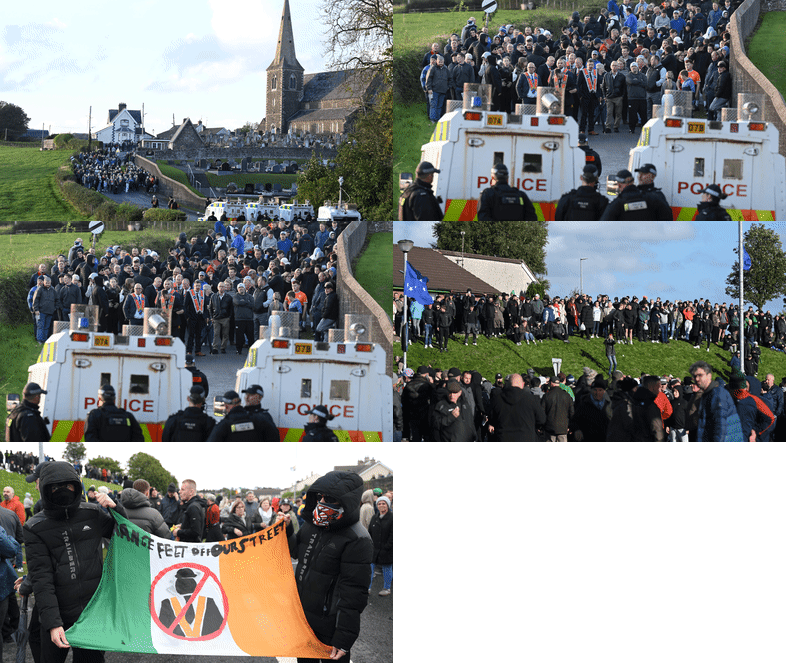
Portadown is back on edge. Nearly thirty years after the Good Friday Agreement was signed, the ghost of Drumcree has returned to haunt Northern Ireland. Two thousand protesters took to the rain-slicked Garvaghy Road, blocking what was meant to be the first Orange Order march through the Catholic area in decades.
It's a high-stakes standoff. High Court rulings clashed head-on with grassroots community resistance, pulling senior political figures right into the middle of a street protest. If you thought the old sectarian battlegrounds had quieted down permanently, Sunday's chaos proved just how fragile the peace really is.
The Court Ruling That Sparked the Firestorm
Let's look at how we got here. For nearly three decades, the contentious route down Portadown's Garvaghy Road was banned. The restriction became a cornerstone of post-Troubles stability, keeping a lid on explosive tensions that defined the mid-1990s.
Then came the procedural loophole. The Parades Commission had initially kept the ban in place for the year, but Belfast’s High Court quashed that decision in August due to a technical error. A late-night sitting dismissed a subsequent resident application to stop the march entirely, giving a scaled-down group of 35 Orangemen the green light to proceed.
Legal technicalities don't translate well on the ground. When a court says yes to a parade that locals spent a generation keeping out, people don't look at law books. They look at history. And history tells them that certain marches aren't about cultural heritage; they're about dominance.
Political Leaders on the Front Lines
What makes this flare-up different is who showed up to block the road. Sinn Féin leader Mary Lou McDonald and Northern Ireland First Minister Michelle O’Neill didn't watch from a distance. They stood shoulder-to-shoulder with the crowds on the Garvaghy Road overnight, calling the situation primitive and intolerable.
Naturally, unionist leaders hit back hard. Democratic Unionist Party leader Gavin Robinson didn't mince words, calling the ministers' participation in an unlawful protest shameful and accusing them of giving two fingers to the rule of law.
When government ministers actively defy a court-sanctioned parade alongside thousands of protesters, the apparatus of power starts fracturing. Power-sharing arrangements in Stormont are already notoriously delicate. Dragging them into direct street confrontations tests those institutional bonds to their absolute limit.
The Historical Echo of Drumcree
You can't understand Portadown today without looking backward. In the mid-1990s, Drumcree Church became the epicenter of a bitter global news story. The Orange Order, commemorating Protestant King William of Orange's 1690 victory at the Battle of the Boyne, insisted on walking their traditional route. Nationalists viewed it as an aggressive display of sectarian triumph.
The resulting violence nearly derailed the peace process entirely. The compromise that eventually banned the march down Garvaghy Road bought relative quiet for nearly thirty years.
Now, the Orange Order members in their bowler hats and silk sashes are waiting near Drumcree Church, while residents vow they are putting the clock forward, not backward. They aren't looking for a compromise. They want a permanent halt.
What Happens Next for the Peace Process
International co-guarantors are scrambling. British Prime Minister Andy Burnham and Irish Prime Minister Micheál Martin both called for immediate calm, warning against sliding backward. British minister Chris Bryant flew back from a party conference in Liverpool to hold face-to-face emergency talks in Belfast.
Yet, appeals for compromise sound hollow when both sides are dug in this deep. The Orange Order wants its traditional route restored after a 30-year exile. Residents refuse to see what they fought so hard to stop return to their doorsteps.
Peace in Northern Ireland was never a self-sustaining machine. It requires constant maintenance, delicate diplomacy, and a whole lot of restraint from leadership on all sides. When courts overrule community consensus and first ministers join street blockades, that machinery starts grinding to a halt. Watch Portadown closely. It's testing whether the foundations built in 1998 can actually survive the weight of the past.